Footnotes to Lodge History:
Footnotes
1 HISTORY OF FREEMASONRY IN TENNESSEE,1944, C.A. Snodgrass
2 Dispensation issued by M.W. Grand Lodge of Tennessee October 10,1867 under the Hand and Seal of The Grand Lodge of Tennessee and Grand Master Joseph M. Anderson, copy attached.
3 This building still stands and is in regular weekly use by the Saundersville United Methodist Church. The building is the small white church on Gallatin Pike located across the highway from Music Village.
4 Charter issued by M.W. Grand Lodge of Tennessee October 6,1868under the Hand and Seal of The Grand Lodge of Tennessee and Grand Master Joseph M. Anderson. A copy of this Charter as well as the original Dispensation we operated under is attached and bears inspection as it points 5 One cold winter's night in 1886, as a pair of dignified and serious minded old Masonic cronies descended the steps from the Hall of Cumberland Lodge on Church Street in Nashville. One of them said, "Bill, let’s build a Masonic Home". They were Bro. Marcus B. Toney and Bro. William H. Bumpas-(Grand Master, 1898)-and build it they did, with the continuing support of Tennessee Lodges. HISTORY OF FREEMASONRY IN TENNESSEE, 1944, C.A. Snodgrass.
A Charter of Corporation was issued in 1886 as the Masonic Widows' and Orphans' Home. The home was located on 220-acre dairy farm five miles out of Nashville. The dairy, along with the other farm products produced there, helped with the overall expense of the home. A school was established there to enable the children to receive a proper education.
The home operated with a capacity of 400 until the early 1930's when it was phased out and our widows were given the opportunity to remain at home and still receive assistance. This practice is still followed today and is the envy of some of our sister jurisdictions who still maintain homes at considerable cost to operate. St. John the Baptist Day (June 24) is known and must be observed as Widows' and Orphans' Day and Lodges are requested to make special donations to the Widows' and Orphans' Fund on that day. LODGE OFFICERS TRAINING MANUAL, Grand Lodge of Tennessee,1985.
During construction, the Corner Stone was laid with appropriate ceremony by Judge Henry H. Ingersoll, Grand Master, and a time capsule encased. After the home was closed, the buildings were razed and the time capsule which had been encased in the home's Corner Stone was removed and opened. This capsule and its contents can be observed in the Grand Lodge Museum today.
6 Other outbreaks of Yellow Fever had hit in the past but, none with the effect or calamity of this outbreak of 1878. In Memphis, of a population of 45,000, twenty-five thousand fled the city in mortal terror, many only to be stricken and die at distant points disease with a total death toll of 5,150. It lasted but four months, but they were months of horror and misery, after passing the disease on. Of the 20,000 that remained, 17,600 contracted the disease.
7 This memorial remains a source of continuing pride for all Masons and is a worthy tribute to one of the greatest Masonic founders of our Country. The Tennessee Grade Lodge still supports this memorial with aid for its continuing preservation. No trip to this area of the Country would be complete for a Brother Mason without a visit to both this and the Scottish Rite House of the Temple in Washington, D.C.
8 This Old Mason's Home operated for a number of years and was located on the grounds adjacent to the Masonic Widows and Orphans Home in Nashville. HISTORY OF FREEMASONRY IN TENNESSEE,1944, C.A.Snodgrass
9 Bro.Wilkins Tannehill originally brought together the official and approved work to be used in Tennessee Lodges in his MASONIC TEXTBOOK, or TANNEHILL'S MANUAL, originally published in 1820 and subsequently republished and updated on a regular basis until being replaced by THE TENNESSEE CRAFTSMAN. This work, as have nearly all Manuals and Textbooks, was originally based in large part on the monitorial work as set forth by William Preston in his ILLUSTRATIONS OF MASONRY,1772.
10 HISTORY OF FREEMASONRY IN TENNESSEE,1944, C.A.Snodgrass
11 In 1990 Worshipful Master Gary Howse resumed the tradition of candlelight and the first section of Master Mason degrees are now once again solemnly conferred under candlelight.
12 This was a requirement of THE MASONIC CODE when a Lodge is named for a locality and changes its situs. The name must be changed but the current number will be retained. Sec. 4.1111. During the Grand Lodge Proceedings of 1990 this section of THE MASONIC CODE was amended so that this name change would now be optional.
Past Masters
Hendersonville #359
*A. Matthews 1867, 68
*WH Wise 69, 70, 72
*HP Anderson 71
*JH Wise 73, 74, 84
++D Stilles 74
*RJ Gilham 75, 77
*JL Manson 76
*CS Douglas 78, 85, 86
*DJ Roberts 79
*AH Murray 80, 81
*PB Willis 82
*TG Wright 83
*WL Franklin 87,88, 1901
*BM Doxey 89
*SD Butler 90
*RS Murray 91,92,97,98
*RE Saunders 93,94,1914
*GS Johnson 95,96
*TI Jones Sr 99, 1900,02
*HS Shute 03
*EW Davis 1904,05,15,29
*GE Noland 06
*GW Wise 07,08
*DB Puryear 09
*JC Franklin 10,11
*BS Wise 12
*BH Brew
*JL Baker 18,27,28
*WH Wise 19
*TJ Rutherford 20
*HR Jones Jr 21
*JH Wise Jr 22,30
*TL Jones Sr 13, 16,24
*RH Long 25
*EL Ferrell Jr 31
*JD Dickerson 26,32,37
*JG Johnson 33,36
*LT Moss 34,42
*AC Scott 35
*HB Roney 38, 44
*WE Hill
*GW Light Jr 40
*JB Ferrell Sr 41
*AM Dickerson 43
*LF Hurt 45
*JC Smith 46
*ER Bradley 47
*AM Ferrell 48
*JH Cage 49
*EA Stone 50
*JH Lee 51
*VR Hunter 52,57
*CA Roberts 53
*WAKirby 54
*HS Lord 55
*LH Newman 56
*UL Mitchell 58
*TF Harper 60
*ET Saunders 61
*RI Silvey 62
*DO Salle 63
*G Johnston 64
*H Smith 65, 67
*JE Taylor 66
*RH Underwood 68
*J Allinder Jr 69
*HM Heer 70, 78
*D Ferguson 71
J Wolfe 72
*D Lewis 73
*A Lane 74
*HS Vanderen
S Dixon 76
K Dudney 77
C Moore 78
T Wynne 79
*W Woodis 81
*C Franklin 82
+C Weist 83
*B Gregory 84
*W Spann 85
*D Hendricks 86
+A Helms 87
R Williams 88
*J Kennedy 89
G Howse 90
*WE Pepper Sr 91
L Wilson 92
+S Gaines 93
*C Walker 94
*F Stein 95
B Woodward 96
*D Burton 97
*T Hensley 98
D Escue 99
*J Stewart 2000
K Walker 01
J Weaver III 02
+D Lewis 03
L Snider 04
*G Ornes 05
P Pike 06
*F Cherry 07
R Lynch 08
+J Johnston 09
D Dunn 10
T Wright 11
*F Clark 12
T Morgan 13
R Moore 14
J Patterson 15
G Freudenthal 16
*D Woodard 17
G Lippard 18
T Stottlemyer 19
C Moore 20
J Phillips 21
J Mercer 22
D Jones 23
W Falbe 24
J Gerock 25
History of Hendersonville Lodge #359
This Lodge was Chartered Oct. 6, 1868 under the following:
Warrant or Charter
Sit Lux et Lux Fuit
Joseph M. Anderson Grand Master
Jonathan S. Dawson Deputy Grand Master
John W. Hughes Senior Grand Warden
R.M. Edwards Junior Grand Warden (pt)
WE THE GRAND LODGE of the Most Ancient and Honorable Fraternity of Free and Accepted Masons of the State of Tennessee in Ample Form assembled, according to the Old Constitutions, regularly and solemnly established under the Auspices of PRINCE EDWIN, at the City of York, in Great Britain, in the year of Masonry 4926,viz:
The Most Worshipful Joseph M. Anderson, Grand Master
The Right Worshipful Jonathan S. Dawson, Dep. Grand Master
The Right Worshipful John W. Hughes, Senior Grand Warden
The Right Worshipful John C. Abernathy, Junior Grand Warden
Do, by these Presents, appoint, authorize, and empower our worthy Brother Alexander Matthews to be the Master; our worthy Brother William H. Wise to be the Senior Warden; and our worthy Brother Joseph L. Gray to be the Junior Warden, of a Lodge of Free and Accepted Masons, to be, by virtue hereof, Constituted, formed, and held in Saundersville, Sumner County.
Which Lodge shall be distinguished by the Name or Style of Saundersville Lodge No.359, and the said Master and Wardens, and their successors in office, are hereby respectively authorized and directed, by and with the Consent and Assistance of a Majority of the Members of the said Lodge, duly to be summoned and present upon such Occasions, to Elect and Install the Officers of the said Lodge as Vacancies happen, in manner and form as is, or may be, prescribed by the Constitution of the Grand Lodge.
And further, the said Lodge is hereby invested with full Power and Authority to assemble upon proper and lawful Occasions, to Make Masons, and to Admit Members, as also to do and perform all and every such Acts and Things appertaining to the Craft as have been and ought to be done, for the Honor and Advantage thereof, conforming in all their proceedings to the Constitution of this Grand Lodge, otherwise this Warrant, and the Powers thereby granted, to cease and be of no further effect.
Given under our Hands and the Seal of our Grand Lodge, at the CITY OF NASHVILLE, in the United States of America, this Sixth day of October in the Year of our Lord One Thousand Eight Hundred and Sixty-Eight and in the Year of Masonry Five Thousand Eight Hundred and Sixty-Eight.
Jno. Frizzell, Grand Secretary
When the veterans of Tennessee returned to their homes after the war, some from the Union, some from the Confederate Armies, they found little but devastation and ruin. History records that Tennessee suffered more from the exhaustion attendant on the close of the war, and from the rigorous extremes of government which accompanied the period of reconstruction, than any other State except Virginia.
The devastation wrought by contending armies, the bitterness engendered by division in sentiment and allegiance through four years of war, were obviously difficult to overcome, but through the gloomy reconstruction days, Freemasonry rose superior to political and civil strife, as veterans of the Blue and the Gray united harmoniously in their Masonic labors, and wielded an influence that proved beneficial to all.
Many Lodges had closed and forfeited their Charters as a result of the anti-masonic movements of the 1830's and 40's as well as the great conflict, but were later reorganized under new Charters and numbers, or new ones were organized in the same communities and areas. The war had contributed to a new awakening of interest in Masonry, and many men were made Masons during the war in Military or Travelling Lodges. Also, many Masons renewed their interest and activities so that after the war, these brothers returned to their homes and communities with a vigorous interest in Masonry which resulted in the need for establishing new Lodges in which to work. Such was our case.1
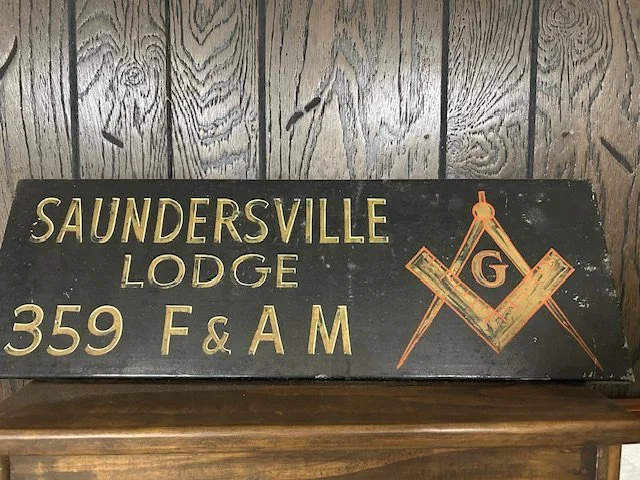
Our Lodge has not always been located in Hendersonville, nor has it always been named Hendersonville Lodge No. 359. We originated as a group of York Masons of the Chapter at Beech Lodge No.240 who, due to the difficulties of transportation of the day, needed a Lodge closer to their places of abode. With the help and regular support of Beech Lodge, a new Lodge to be called Saundersville Lodge No. 359 was established at Saundersville, Tennessee.
Throughout its history, this Lodge has successfully weathered the storms of five major periods of war in the United States as well as the dark days during Northern occupation and the period of Reconstruction and carpetbaggers, survived the money panic of 1907 and the great depression of the thirties, as well as the vicissitudes of the passing years. During all these troublesome periods, the brethren have continued to conduct business, have maintained the Lodge Charter, and have held regular Lodge sessions, a continuing struggle we should all be thankful they fought and won.
The first meeting of the newly established Saundersville Lodge No.359, under Dispensation from the Grand Lodge of Tennessee, was called and opened October 14, 1867. This dispensation had been issued October 10, 1867, by Bro. Joseph M. Anderson, Most Worshipful Grand Master of the State of Tennessee. "...Know ye that we the Worshipful Joseph M. Anderson, Grand Master, at the humble petition of our Worshipful and well beloved Brethren...of the Ancient & Honorable Fraternity of York Masons and for certain other reasons moving our Worshipful Grand Master, do hereby constitute the said Brethren into a regular Lodge of Free and Accepted Masons to be opened at Saundersville in the county of Sumner, Tennessee, by the name of Saundersville Lodge, No. 359...2 Those present at this meeting were Worshipful Master Alexander Matthews, Senior Warden William H. Wise, Junior Warden (pro tem) Albert G. Dunn, Secretary Cornelius Weistling Callender, and Brothers Martin B. Shelton, F.C. Winham, G. E. Dismukes, G. S. Watson, S. F. Hughes, Jno. F. Puckett, H.F. Anderson of Beech Lodge No. 240, Jas. H. Warfield of Washita Lodge No.116, Ark. On a motion, the code and by-laws of Beech Lodge No. 240 (with the exception of time of meeting) were adopted and the officers designated above were named to serve until a regular election could be held. The next meeting was set for October 28,1867.
At this second meeting, the regular order of business included receiving the demits of Brothers G. S. Watson, J. C. Draper, Jacob Wise, Jno. H. Turner, Jno. F. Cage, Jno. W. Franklin, John M. Shute and S. F. Hughes from Beech Lodge No. 240. The petition of Mr. Felix G. Talley was received for the First Degree in Masonry. A motion was made and passed that "the regular meetings of this Lodge shall be held at early candle lighting on each Thursday on or before the full moon."
The third meeting was held November 5, 1867. Several more petitions for demits from Beech Lodge No. 240 were received. Bros. Callender, Gray, W. Wise and Matthews were appointed a committee to provide Aprons, Jewels, etc. At the next meeting on December, regular elections were held to fill the offices during the term of the dispensation with Horace F. Anderson elected Senior Deacon, Jacob H. Wise Junior Deacon, Albert G. Dunn Treasurer, Cornelius Weistling Callender Secretary, H.HH. Saunders Tyler, Jno. F. Puckett and L.F. Hughes Stewards, and B.F. Ferrell Chaplain. A Lodge was then opened on the First Degree and Mr. Felix G. Talley appeared and was initiated an Entered Apprentice Mason, this being the first degree to be exemplified by Saundersville Lodge.
The first Fellowcraft Degree was conferred February 6, 1868, this also being upon Brother Felix G. Talley who later received the first Master Mason Degree conferred, May 7, 1868.
A contract had been drawn February 9, 1867, between the building committee composed of members of the Methodist Episcopal Church South with the prospective Saundersville Lodge and Mr. James H. Douglass, contractor, for construction of a new church at Saundersvile. This church was to be completed by or before November 1, 1867, on land already owned by the church and was to be modeled on the existing Bethel Church. The church was to occupy the first floor with the newly formed Lodge occupying the second floor in a room 22 feet by 50 feet with exterior entry by stairs. The contract also stipulated that the Lodge could not sell their interest in the building without the church's consent and could not obstruct the sale of the building by the church should the church ever wish to do so. Also, a stipulation was included allowing the Lodge to rent their rooms to the Sons of Temperance for a monthly meeting for the rental fee of twenty dollars per annum. The cost of this edifice was $2500 with this expense borne three-fourths by the church and one-fourth by the Lodge, the same proportions to be allocate for future repairs needed.
By recommendation of the Grand Lodge, the Lodge adopted the New Constitution and By-Laws by unanimous vote August 27, 1868. The Charter for Saundersville Lodge No.359, Free and Accepted Masons was issued by the Grand Master, Joseph M. Anderson, Grand Lodge of Tennessee October 6, 1868, and the previous dispensation surrendered. We still work under this same Charter which is hanging in the Lodge as required under the Tennessee Masonic Code; "...the said Lodge is hereby invested with full Power and Authority to assemble upon proper and lawful Occasions, to Make Masons, and to Admit Members, as also to do and perform all and every such Acts and Things appertaining to the Craft as have been and ought to be done....4
The first election and installation of officers of the newly Chartered Lodge was held December 24, 1868. An audit committee was then named and reported at the next meeting on the finances including the balance of $100.00 owed on a loan from Beech Lodge No. 240. This was initially loaned from Beech to aid Saundersville in their formation and most of the original members of Saundersville were previously members at Beech. This loan was later repaid in full January 25, 1872.
At the stated communication of March 25, 1869, the members present voted to rent the Masonic Hall to the International Order of Odd Fellows for their use in forming and holding their meetings, until that body could obtain suitable quarters. Nor was this to be the last time we cooperated with local groups in permitting use of the Lodge premises and grounds.
On May 20, 1869, Brother W. A. Nelson, Grand Chaplain of the Grand Lodge of Tennessee made a touching presentation on behalf of the Masonic Orphans Home, an undertaking on which the Grand Lodge had determined, to erect a home for the care of Masonic widows and orphans. The Lodge then voted a yearly contribution of twenty-five dollars for the next ensuing five years and fifty dollars for five succeeding years. Throughout the succeeding years various subscriptions were purchased by the Lodge and events such as public entertainments and picnics given to raise funds for this worthy enterprise. Over the years the fund grew until in 1886construction began and in 1889 was completed. This home continued to operate for many years
in Nashville as The Masonic Widows and Orphans Home.5 This home was the third Masonic Home to be established in these United States and continued in successful operation for over 40 years.
December 1, 1870, the By-Laws were amended to provide for semi-annual election and installation of officers. New officers were then elected and installed for the next six months. Later, previous to the next scheduled election, this amendment was rejected by the Grand Master and the By-Laws returned to their previous provisions.
Curious occurrences come to light in several instances such as that which occurred the evening of December 17,1874. At the Stated Communication that evening, Bro. R. J. Gillham was elected to membership in this Lodge by affiliation and also elected Master of the Lodge for the next ensuing year, having previously served as Warden and Master in the Lodge he affiliated from.
June 24, 1875, was a particularly special day for the Lodge. A special joint meeting was held with Beech and King Solomon Lodges for the dedication of our hall. All member's families were invited and a delegation of Grand Officers received in the usual form. The hall was dedicated according to ancient form and usage with very beautiful and impressive ceremonies and a large feast with plenty of food and music later ensued. By now, the membership roster was up to 32 Master Masons, having shown a considerable growth since the formation of the Lodge. The "Uniform Code of By-Laws" as recommended by the Grand Lodge was adopted March 9, 1876, and remains the basis for By-Laws used by all Lodges in Tennessee. Fees remained unchanged at this time though, a total of twenty-five dollars for the Three Degrees with annual dues of two dollars plus an assessment of one dollar for the Masonic Orphans Home.
The regular communication was held September 20, 1877, where a resolution calling for "the Secretary to notify each member to be present at the next stated meeting to discuss the propriety of moving this Lodge to Hendersonville, or of granting a recommendation to certain Brethren who proposed petitioning to the Grand Lodge for the purpose of establishing a Lodge at that place." This was voted down at the next meeting but was to reoccur in later years as the general population growth shifted toward Hendersonville.
An event which we have continued to observe in most years was first held December 21, 1877. This was the date of the first public installation of officers. All member's families were invited and a large dinner scheduled after the proceedings. Prior to this, all installations were held at the stated meetings and were not open to anyone but Master Masons.
Occasionally, items appear in the minutes which are amusing or of definite insight to conditions prevailing at the time. In the modern day it is all too easy to forget that our ancestors had not all the conveniences which we generally take for granted. One such entry is the following which appears in the minutes of the stated meeting of February 14, 1878; "Resolved, that the Tyler be authorized to buy a new Dipper of Brittania or White Metal, and that our old and rusty friend, the one now in use, be laid up as a memorial for future generations that this Lodge is accustomed to drinking only pure water during its deliberations." The next month, on motion of the Senior Warden, the Secretary was ordered to pay "Bro. J. H. Wise 60 cents for a dipper purchased by him for the use of the Lodge and that he enjoy the thanks of this Lodge for the same." At the January 14, 1889, stated meeting a motion was made and carried for the Lodge to purchase lamps for the hall. Three lamps, three hooks to hang them and coal oil were purchased before the next meeting, this providing the first fixed lighting for the Lodge. Prior to this time, all lighting appears to have been from candles and buggy lamps.
Masonic Relief has always been a cornerstone of Freemasonry. The history of our Lodges is replete with examples of this worthy undertaking. In 1878 the Yellow Scourge struck Memphis6 and spread throughout much of the State with devastating fury. As the epidemic took hold, Saundersville Lodge, a very small country Lodge, voted to appropriate the sum of twenty-five.
dollars to the Grand Lodge for relief of Yellow Fever victims in September 1878. Today this may not sound like much money but, it was fully a fourth (twenty-five percent) of the total assets of Saundersville Lodge at the time. On the Minutes are spread many other such examples where the Lodge gave unstintingly to aid a wide variety of needs, both within our Lodge and from other Lodges or outside sources, both here and abroad.
Many important and impressive events occurred through the years at this Lodge which helped spread Masonic Light among the brethren. Several examples of these include Grand Master W.H. Bumpas giving a talk on the duties and benefits of Masonry and conferring the sublime degree of Master Mason on a Brother of our Lodge (October 27,1898); August 16-17-18, 1899 Grand Lecturer W. H. Jolly held a three day Masonic School of Instruction at Saundersville Lodge where Brethren from a great number of Lodges in the 4th district attended and benefitted greatly. Most Schools of Instruction at the time were of two- or three-day duration due to the difficulties of travel with members from out-of-town Lodges generally being housed and provided other hospitalities by the host Lodge members and their families during the stay.
To this day the most solemn work performed by a Lodge is the bestowal of Last Masonic Rites. The members would first assemble at the Lodge to open then proceed to the funeral. This was generally done at the deceased member's home with a procession then being made to the cemetery for Masonic burial services. In many cases, two or more Lodges would assemble together for these services. The Brethren would then return to the Lodge for closing (or in some cases retire to a secluded corner of the cemetery to close the Lodge) and generally appoint a committee of three to draft resolutions of memorial or obituary which would be spread on the minutes, printed in the local newspaper (usually the Gallatin Examiner) and a copy given to the deceased's family. These resolutions were extremely touching and loving tributes to the deceased Brother and in addition directed the Lodge members to wear the usual Badge of Mourning for thirty days. Even though this custom has undergone changes through the years, both in the actual service performed as weIl as the other details, this remains a most solemn and beautiful work and is available for all Master Masons at their or their families' request.
In 1909 a motion was made to amend the By-Laws to read, "The stated meeting of this Lodge shall be held on the Thursday on or before the full moon. The hour of assembling shall be 2o'clock P.M." This appears to have been the day of the week that Hendersonville and Gallatin merchants closed at noon and would thus allow the Lodge work to begin earlier but, this motion failed on vote at next meeting principally due to the hardship it would work on those brothers who were farmers, of which there were still a number.
Also, during this year, the national movement for erection of the George Washington Memorial at Alexandria, Virginia, was inaugurated, a movement which the Tennessee Grand Lodge duly approved and commended to the support of all Masons in this Grand Jurisdiction. At the August 26th stated meeting a communication from Fredericksburg Lodge No. 4, Virginia was received and read regarding this monument and appealing for financial aid to help in its construction. At various times over the years this Lodge donated money to this cause and approved a regular portion of the initiatory fees to be used for this purpose as well as for the continuing maintenance and operations of this memorial.
In 1911 Grand Master John. Rison proposed to Grand Lodge the erection of an "Old Mason's Home" also recommending an increase in per capita tax to provide sufficient funds for the Home.8 This was erected over the next few years and was funded by regular donations from individual Lodges including this Lodge as well as individual pledges.
Also in 1911, the Lodge was first carpeted which greatly increased the comfort level in the Lodge. This amounted to included 50 yards and was obtained through the Franklin & Pierce Dry Goods Company for a cost of $19.98! After this, the tyler, W. D. Williams was then ordered to purchase window shades and spittoons to help protect the new carpet.
In June 1914 a storm broke over Europe with nations being drawn one by one into the holocaust now known as World War I. On April 6, 1917, the United States declared war on Germany and by June young men throughout the nation were enlisting. This war effort had several effects on our Lodge, as well as others. Many of our brothers enlisted or were called up to go to war "over there." The dues of these brothers in service or training camps were remitted as a mark of patriotism. Also, a resolution was passed at the start of 1918 to refrain from serving refreshments at Lodge meetings during the period of the war in an effort to conserve food for the war effort.
In several instances, communications were received from military training camps requesting financial help in erection of buildings for Lodge halls on the bases for use of Masons in training on these bases. The Lodge made various donations as well as individual pledges on several occasions, thus aiding in this worthy effort to further spread Masonic Light and assist Masons far away from home to continue to enjoy Masonic fellowship.
At the Annual Communication of 1917, approval was given for the publication of a pocket edition to be called THE TENNESSEE CRAFTSMAN, which was published at that time to be used as the standard monitor for Masonic work in this state. This essentially replaced the Tennessee Masonic Textbook which had been in use since 1820 9 although, did not contain
some of the material found in that book. Currently we use the Twenty-First Edition of The Craftsman which was published in May 1984.
At the Annual Communication of the Grand Lodge in 1920 it was reported that the site of Freemason's Hall (the Grand Lodge building) was desired as a part of the site of the proposed "Memorial Auditorium" that was to be erected to honor the war dead from Tennessee. In due course, Freemason's Hall was sold by the Trustees in 1921, retaining occupancy of the building rent free until March 1, 1922, and in that year, Trinity Consistory of the Ancient and Accepted Scottish Rite, began the erection of the stately Temple at the corner of Broadway and Seventh Avenue, the Corner Stone of which was laid by Grand Master Walker M. Taylor during the Annual Communication of 1923. This building, when completed, became the home of the Grand Lodge and other Grand Bodies.10
In April 1920 a motion was once again made to either move or build a new Lodge Hall and once again, was voted down. At this time the Lodge was undergoing a period of growth and was feeling the need for larger quarters.
Recorded music came to our Lodge and the Order of the Eastern Star Chapter in 1920.The Lodge and Eastern Star went in together on the purchase of a Victrola which saw much use at various meetings and on social occasions. One interesting sidelight; this was the first mention found in the Lodge minutes of the Order of the Eastern Star Chapter but would not be the last.
A very sad event had occurred November 10, 1921, with the death of Brother John M. Shute. He was the last of the original members of Saundersville Lodge, having demitted from Beech in November,1867 and affiliated with Saundersville #359, operating under dispensation, November 9,1867. The memorial to his passing is spread on the minutes for January 12, 1922.
On April 26,1923 a communication from the Grad Master was read requesting help collecting information to be used in writing a history of Tennessee Freemasonry. A committee of three was appointed to "hunt up and collect any and all incidents of Masonry of early date and forward the same" This effort throughout the Lodges of the state culminated in the publication of a HISTORY OF FREEMASONRY IN TENNESSEE by Charles Albert Snodgrass in 1944.This work, although now out of print, remains the definitive history of Freemasonry in our State and includes coverage of the appendant bodies as well.
By the Twenties Rural Electrification had come to Sumner County and in 1926 the Lodge was wired for electricity and electric lights installed, the work being completed by Brothers G.O. Duncan, O. L. Potts, and A. W. Long. The minutes reveal that the Lodge had to guarantee the light company as much as one dollar (one whole dollar!) per month in order to get electric power. Thus, gone were the days of coal oil lamps although, for a number of years, candles continued to be used around the altar.11
In 1927 the Grand Lodge directed that the fee charged for The Three Degrees in all Tennessee Lodges be at least thirty-five dollars. In response, the Lodge voted almost unanimously to increase the fee to forty-five dollars, fifteen for each degree. This was later reduced back to the previous level in 1932. The Depression dealt Masonry a severe blow everywhere as Brothers struggled to pay their dues and the number of petitions decreased. Our Membership was down to 57 by 1935, and times were so hard and the finances so tight that the Lodge insurance was dropped during most of this time, and there was even some discussion of surrendering our Charter, this being vetoed unanimously. With the perseverance and dedication of the Brotherhood we survived, and growth resumed again during the early Forties.
On January 5, 1928, after a unanimous vote, our By-Laws were amended to change the time of the stated meeting from "Thursday on or before the full moon" to read "the Thursday night of each month at 7:30 P.M."
Brother P.H. Brew, secretary of the Lodge, was ordered on June 19,1930 contact Brother Luther E. Dorris at Springfield to order a Masonicscope for the sum of $57.50. This Masonicscope was an early form of projector which was used much as we use our current projector to display masonic scenes and charts during the lectures. Although we no longer have this instrument, a representative sampling of the same can be observed at the Grand Lodge Museum downtown. Prior to ordering this instrument, the masonic charts accompanying the lectures were displayed on wall hangings, charts and/or floor cloths.
Throughout these years of economic depression, the Lodge and the Church remained the prime centers of fellowship and social life in the community. The Brethren of Saundersville are noted to have had a great fondness for oysters (fresh water) as on many an evening of work and fellowship, the minutes record that dinners or snacks consisting of fresh oysters, crackers and hot coffee was provided by the Stewards.
Our first Board of Trustees was appointed by Brother J. G. Johnson WM at the stated meeting July 16, 1936.These first three were Brothers Woodford Hall Dunn, James D. Dickerson and George W. Light, Jr., one to rotate off and a new Trustee to be appointed each year. These Trustees were assigned the duties of overseeing the affairs and business of the Lodge, a duty which they are still pledged to fulfill. The only change in this arrangement is that now we have five Trustees, and they are all required to be Past Masters.
During 1937 the Lodge voted to join the Masonic Service Association, an organization established to operate a program of hospital visitation for veterans and to create and maintain a library of educational materials useful in Lodges. These materials are available at very reasonable cost to any Mason and individual memberships are well worth the small cost involved.
Also, in 1937 we celebrated the 150th anniversary of the Constitution of the United States of America. All Lodges across the country were encouraged to join this celebration of freedom and Saundersville joined in with a meeting held September 16 at which time Brother J.A. Luna, Chaplain made a presentation on Freemasonry and the Constitution in the founding of this country.
Throughout the years, Travelling Degree Teams have remained popular. Some of those which have exemplified the Degrees in our Lodge have been those from other Lodges such as King Solomon #94 and the Old Hickory Scottish Rite Team. Also, there have been various other teams operating through the years with several being the Nashville Police Department Team and General Shoe Corporation Team. All these and many more have visited our Lodge at various times and in several recorded instances our Lodge Brothers got together proficient teams such as these and conferred the Degrees at other locations.
Once again, the United States was drawn into a great war and Masonry met the challenge. Many of our worthy Brothers entered the service to fight against Germany and/or Japan. On January 15,1942 a communication from the Grand Master was received instructing all Tennessee Lodges that in future, all meetings would open with the Pledge of Allegiance to the Flag of the United States of America, a custom which continues unchanged. Also, Lodges were encouraged to purchase National Defense War Bonds as financial conditions permitted, and this was readily done on several occasions by Saundersville Lodge. Many of the brethren not enlisting or called up for the war were involved with the Red Cross as volunteers. There was also a concerted effort among the Lodge Brothers and the Eastern Star to regularly write letters to our brothers-in-Arms during this period and, once again, dues were remitted for those engaged in the war efforts overseas.
On October 6,1943 Saundersville Lodge celebrated its 75th anniversary. Although the event was apparently somewhat subdued because of the war, a picnic was held at the Saundersville schoolhouse with all members and their families invited to bring a basket. The featured speaker at this occasion was Brother Ben West of Nashville.
We are all brothers in Masonry but in 1950 we had a family of brothers become Brothers. During January, February and March three brothers made the journey together, Luther Hall Newman, Haggard Wright Newman and Henry Franklin Newman having all three degrees conferred upon them together. The Master Mason degree was conferred by the Nashville Scottish Rite Club Degree Team, an event which drew a large number of visitors.
During early 1951 Beech Lodge No. 240 burned. As the Lodge could not be used during its reconstruction, the brethren of Beech requested to be allowed to use Sandersville’s hall during this period of time which was cheerfully allowed. Saundersville Lodge offered any and all possible aid and assistance during this time of hardship for our brothers from our Mother Lodge.
In March 1955 a photostatic copy of our original Charter was made and hung in the Lodge. The precious original was safely stored away in the vault at the Bank of Hendersonville, along with other valuables.
On June 9, 1955, a special meeting was held at the Hendersonville VFW building to present 25year pins to all members applicable. Their families were invited and the guest speaker was Grand Master Henry Conn, whose topic was "Treasures at Home." A large dinner was served, and these pins were presented to 13 Brothers with several others being mailed to those who could not attend. It was interesting to note that as the Lodge Hall at Saundersville was very small, any event of size was held either outside or at this VFW hall with this being a fairly frequent occurrence.
In the early 1950's Freemasonry began a period of rapid growth throughout Tennessee. The Grand Lodge Synopsis for 1956 shows a total membership of 85,404, this representing a net gain of 2234 from the preceding year. During this period of time and throughout the 196O's and 1970's a huge number of Petitions for the Three Degrees were presented, and growth was rapid resulting in a large amount of Lodge work to be conferred.
Spread on the minutes are occasional colorful comments such as that of June 16,1960, where the secretary, Brother Jim Ferrell, makes an interesting comment in the margin, "Rained so hard for a while could not hear each other talk. Old building really swayed." The old building, though almost 100 years old, had many original features still in use such as the coal stove which was not replaced until October 1962 when natural gas was connected to the building and a furnace installed.
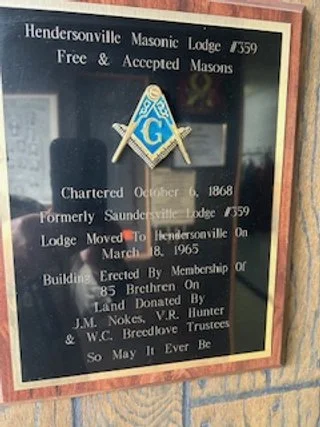
In 1962 an offer was made to the Lodge for a lot in Hendersonville. A committee consisting of Brothers Thomas Harper, Hall Smith and Douglas O'Saile was appointed to investigate this offer. It was found that the offer was made by Mr. J. M. Nokes (with Bros. Virgil R. Hunter and W. Cornelius Breedlove acting as his trustees) to donate the lot at the corner of Shackle Island Road and Hunter's Trail if the Lodge would build a new Lodge Hall there. On June 18,1963Worshipful Master Gowan Johnson read the report of Grand Lodge requirements for moving the Lodge. The Masonic Code required that if the Lodge moves it will keep the number but will lose the name Saundersville (it being named for a location). The requirements of the deed including the time frame stipulated was then read.
A standing vote was taken on whether or not to move the Lodge to Hendersonville and the outcome was almost unanimous. It was also voted to construct a one-story structure. As a result of this stated meeting and the votes taken, it was now decided; the Lodge was moving to Hendersonville, having been in the same location for 95 years!
The deed for the new property as presented and read included the following restrictions and conditions which were agreed to by vote of the membership:
1) Property may be sold should it be deemed best by three-fourths of the resident membership of the Lodge provided the proceeds are used in the furtherance of Masonic work or for charitable purposes, but in no event shall the property be sold before January 1,1990.
2) That a plaque be installed in the entrance giving the history of the Lodge containing details of the land being donated by J. M. Nokes and Virgi R. Hunter and also containing the names of all members..., as per sketch to be prepared by the architects.
3) Provided that the Order of Eastern Star, DeMolay and Rainbow Girls may use the facilities, subject to such reasonable rules and conditions as may be imposed by the officers and trustees of the Lodge.
4) That the Lodge Hall shall face Shackle Island Road with not less than 75 feet from centerline of aforesaid road and be located on lot as recommended by the architect.
5) Use of the Lodge Hall shall not be limited exclusively to Masonic work but may be used for the benefit and furtherance of similar work and community projects subject to the approval of the officers and trustees of the Lodge.
6) That the Lodge Hall shall be built and completed as per present plans, for use by the membership of the Lodge and on the herein described tract of land, and have the Saundersville Charter #359 transferred to Hendersonville, Tennessee not later than January 1,1966.
7) That the Lodge Hall shall be constructed of masonry shadow block or regular block with brick veneer.
8) That all the terms, conditions, and provisions herein set forth shall constitute a lien on the property and run with the title thereto.
During February and March several contractors were consulted regarding estimated costs for a new building and a Building Committee appointed to draw up plans and specifications for the new structure. March 19, 1964, found the plans for a new Lodge building submitted, with the Committee explaining the plans, furnishings and approximate cost. A motion was made and carried to give the Building Committee full power in erection of a new Lodge, 40 feet by 80 feet of shadow block construction, the cost not to exceed $20,00O dollars, or if so to report back to the Lodge for further approval.
Based on the deed and security consisting of the lot, future building and a note for $7000 dollars, the Bank of Hendersonville agreed to make a loan of $15,000 dollars on a first mortgage basis, to be amortized over 15 years with a balloon note payable in the tenth year, the stated rate of interest being 5 3/4%
An initial bid of $25,300 was received, this then being cut to $20,000 by deleting various interior finishing work which would later be done by the members themselves. Finally, on October 15,1964 all details had been ironed out, and a vote was made to start on the construction immediately. The design was upon the Trestle board and construction work could now proceed without delay.
At the February 18,1965 stated meeting it was reported that Brother Robert Gregory (not a member of this Lodge) had some marble that came out of King Solomon's Temple. If the Lodge would accept, he would have it cut for the cornerstone. This generous and loving offer was quickly and thankfully accepted.
On March 13,1965 Lodge was called and opened for the purpose of raising Brother Charles A. Black, Jr. to the Sublime Degree of Master Mason. This was the last degree to be conferred in the old Lodge Hall at Saundersvile and the last meeting in that building. The last Entered Apprentices initiated at this hall were Mr. Joe Ward Craighead and Mr. Eugene McQuade on March 1.1965 and the last Fellowcraft degree was the passing of Brother David Lee Ferguson on March 8,1965.
On March 18, 1965, the first meeting in the new Lodge Hall which was a stated meeting took place where the Dispensation granting permission to move the Lodge to Hendersonville was read. A motion was made by Brother Gowan Johnson PM and carried to change the name to
Hendersonville No. 359,12 the minutes then reading, "THIIS LODGE WILL BE KNOWN FROM THIS NIGHT MARCH 18, 1965, FORWARD AS HENDERSONVILLE LODGE NO.359 F&AM."
Finally, after at least six times in this Lodge's history where motions were made and discussed regarding a move, Hendersonville Lodge No. 359 had completed the move to Hendersonville. This ushered in the start of a new era for Hendersonville Lodge. The town of Hendersonville was booming since the coming of Old Hickory Lake in 1956. Population was rapidly growing and new businesses and churches were springing up. The time was propitious for a new Lodge Hall in a growing community and the brothers resolved to do their part in contributing to the community. The first degree exemplified in the new building, and rightly so symbolizing a beginning, was the initiation as Entered Apprentice Masons of Mr. James Edward Smith and Mr. Vance Robert Tanksley on March 22, 1965. In addition to the above degree, the first Fellow Craft degree was conferred March 29 with the passing of three Brothers, Joseph Harold Shanes, Terry Tingley (courtesy work done for Oriental Lodge #240 of Detroit, MI), and J.W. Wiseman. The first Master Mason degrees were conferred April 3 on Brothers Edmund Gillett Mayhall and Irvin Daniel Lewis, Sr.
On August 28, 1965, a public Bar-B-Q was held to help raise funds for the completion of the Lodge. This would prove to be the start of a tradition at Hendersonville Lodge, with the exception of some years during the 1970's at which a Fish Fry was held rather than a Bar-B-This annual Bar-B-Q is now regularly enjoyed the first Saturday in October each year. During these early days in the new building, many of the members contributed countless hours of labor doing finish work, painting, and all the many other chores needed to get the building the way they wanted it. These members cannot be thanked enough for their unstinting labor of love in helping provide the hall we enjoy today.
February 12,1966 marked the presentation of the beautiful Cherry altar we still use to this day. This was presented by Brother Frank Bush for Mrs. Ruth Durham and Family in memory of our late Brother John D. Durham. In August of this year the OES presented the Lodge with nice officer's chairs for the East and West and since then, additional chairs of the same design have been placed at all Stations and places (July 1969).
On February 17, 1966, a committee was appointed to investigate sponsoring of a Rainbow Assembly for girls. This was proposed as a joint venture or project of the Lodge and the Eastern Star Chapter. After much investigation and preliminary work accomplished, a vote was approved to enter into this sponsorship on July 18, 1968.
In February,1967 Hendersonville Lodge started the monthly publication still known as The Trestle board which is provided to all members and Masonic widows Also at this stated meeting, the installation of natural gas for heating was approved to replace the LPG which had been in use for heating since moving. Later this year the Lodge granted permission for use of the hall by a local Scottish Rite Club.
In early 1968 a motion was made, duly seconded and carried to eliminate all smoking in the Lodge during Stated Meetings and the conferral of degrees. Other noteworthy events this year include the establishment of a lifetime membership plan, subject to Grand Lodge approval, a celebration of the 100th annivesary of this Lodge, and the erection by the Eastern Star of the sign at the Southwest corner of the Lodge building bearing the Blue Lodge, Eastern Star and Rainbow emblems and having space for future emblem expansion.
The 100th anniversary celebration committee consisted of Brothers Robert Sudderth, Art Lane and John Wolfe. This celebration marked another of many milestones in the history of our Lodge and pointed the direction to the125tanniversary which will take place in 1993.
During 1969 the Lodge purchased a large stove and assortment of other kitchen equipment from Gates Rubber Company which was shutting down their company cafeteria. Without this equipment, we could not start to put on the annual Bar-B-Q and Pancake Breakfast which continues to help fund operations and improvements for the Lodge. All this equipment was installed by the members as well as other ongoing improvements in the hall.
In February 1971 the OES donated $200 to the Lodge which was then used for the paneling in the dining area. Several workdays were held wherein the Brethren installed this paneling, much improving the appearance of this area.
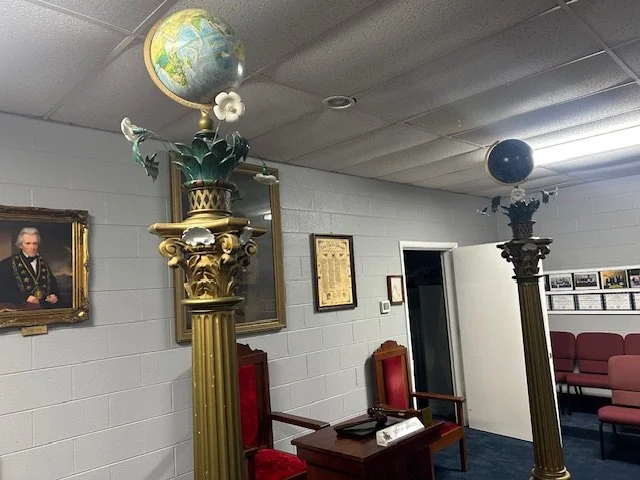
In early 1973 Brother David Campbell, almoner of the Lodge, made a trip to Chicago where he obtained the beautiful J & B brazen pillars which we still use. These were donated by Chicago Heights Lodge #581. Also, this year, the Lodge voted to sponsor a DeMolay Chapter here. Previous to this date many of our members supported the Tom Durham DeMolay Chapter sponsored by King Solomon Lodge #94 in Gallatin. The new Chapter was named in honor of Brother Claude Hendricks who had been the Tyler of the Lodge until recently passing away.
Growth of the Lodge continued steadily over the next decade. On February 9,1974 Brother Ernest Doss Hill was raised to the sublime degree of Master Mason becoming the 300th member of the Lodge. By 1981 the Brethren were discussing the possibility of adding a second story for expansion of the Lodge. After much discussion and checking with an architect this was deemed structurally infeasible and carried no further.
At the stated meeting held November 18,1976, after much discussion, a motion was passed instructing the treasurer and trustees to pay off the mortgage on the Lodge. This was promptly completed.
During 1977 the Lodge accounts were moved to Citizen's Bank in Hendersonville. Also, the new roof was installed on the Lodge to replace the flat roof which had a history of leakage and damage which was principally caused by the roof mounted HVAC unit. Before replacing the entire roof structure with the present gabled roof, the HVAC unit was relocated to its present situation at the rear.
On March 16, 1978, a motion was presented by Brother Charlie Franklin to have the Lodge carpeted. This was passed and completed which resulted in a much-improved comfort level for everyone concerned.
In 1982 the World's Fair was held in Knoxville, Tennessee and Hendersonville Lodge played an important role. A masonic exhibition was scheduled during this time and as part of this each of the degrees was to be conferred. On April 23, 1982, a dispensation was issued by Grand Master John Pigg to Hendersonville Lodge for the purpose of moving the Charter to the Scottish Rite Temple in Knoxville on May 22, 1982, and there to confer the Fellow Craft Degree. On that date a Lodge of Fellow Craft Masons was called and opened at that location for the purpose of passing to the Degree of Fellow Craft Brother Freddie Joseph Toon. This degree was conferred by a travelling degree team composed of Past Masters of Hendersonville No.359.
During 1984 the present gabled roof was added to the Lodge. The old flat roof had been leaking and had been patched numerous times and although this involved a major reworking of the structure, it was necessary for continued use of the Lodge building and also included several other major repairs including moving the heating/air conditioning unit. Also, at this time the pole sign out front was relocated to its present location.
During December 1985 a tribute to the past history of the Lodge was held. This involved the conferral of a degree at the old Lodge Hall in Saundersville above the United Methodist Church and occasioned the issuance of a dispensation granting permission for the same from Grand Master Samuel Chandler. On December 28, 1985, a Lodge of Master Masons was called and opened for the purpose of raising to the Sublime Degree of Master Mason Brother Laddie Lann Wilson. This conferral was performed in the old Lodge Room above the Church by a degree team composed of Past Masters of the Lodge and, of course, occasioned many good memories of past times by the older Brethren in attendance. Brother Wilson has continued his Masonic career and served as Worshipful Master of the Lodge during 1992.
In October 1991 the family of Brother Rufus S. Murray donated his Masonic Apron to the Lodge. Brother Murray had passed away in 1952 in Oklahoma but had previously resided in Hendersonville where he faithfully served as Worshipful Master of this Lodge during the years 1891, 1892, 1897 and 1898. He also filled a number of other places and stations during his Masonic career. Brother Murray was the twenty-fourth Master Mason raised in Saundersville Lodge.
Through the years we have had only one Brother serve more years as Master than Brother Murray. Brother Turner L. Jones, Sr. served as Master six years, these being 1899,1900,1902,1913,1916 and 1924. Many other Brethren have faithfully served us through the years in many positions of responsibility but these two are especially deserving of our memory and respect for the years of unselfish devotion and service they rendered to their Lodge. These Craftsmen have set the mark for noble dedication, a mark which should be diligently aimed for by all of us.
Also, during 1991 the Lodge took on a somewhat different look with the addition of the ramp at the front for disabled access. This had been long needed and came to fruition under the term of Brother Walter Pepper, Sr. We are indeed thankful to Brother Pepper for spearheading this project as our Lodge is now more accessible to all Brethren. In this, as in other actions taken during his years of service to the Craft, Brother Pepper showed the concern and diligence for which he is noted.
Hendersonville Lodge has gone through good times and bad, as have all Lodges. We suffered through the great depression and numerous wars. We enjoyed many evenings of great food, fun and fellowship. We were made better men by our Masonic Labors on countless nights. During the past 20 years Masonry has witnessed a steady decline in membership in most Lodges. At the
present time we are seeing a major expansion in anti-masonic activities from several quarters. But Freemasonry has survived such times before and we will survive these attacks. Each Brother has at his disposal the most effective weapon in existence to fight against these anti-masonic attacks. What is this weapon, you ask? Simply this-- Let each Mason live his Masonry. Live it in our daily lives, in our dealings with everyone, in our family relationships, in our service and stewardship in our Churches, in our community involvements. By doing so, we defeat the attackers by the simple expedient of completely disarming them; they have no standing or grounds for their attacks, and our actions show to any just person that their attacks are mean spirited and unwarranted. This weapon is not only effective, it is feared by those who would wrongly attack us because they know they have no rebuttal or rejoinder for the truth.
This history of Hendersonville Lodge No.359 was researched and prepared by Brother Steven Allen Gaines, Worshipful Master for 1993. It comes in large measure from reading and study of the minutes and other Lodge records as well as a selection of outside sources. This work was completed in early 1993 and presented to the membership in conjunction with the celebration activities commemorating the 125thanniversary of our Lodge. Throughout the preparation of this history, a number of personal recollections have been made by various members and several of these bear recording here.
During 1990 Brothers David and Pat Campbell were sorting through an odd lot of various items they had purchased at an estate sale and made a discovery for which we are indebted. This included a selection of original papers and documents from the very first years of the Lodge. These had evidently been stored in boxes in a garage for many years and no one knew what had happened to any of them. It should go without saying that we were very happy to regain the possession of these precious documents. These items will be sorted and catalogued and them stored with care to prevent another disappearance.
Brother John Taylor relates several stories. One concerned the night he was initiated an Entered Apprentice in the old Lodge. That building was none too sound due to its age and the roof leaked when it rained. Also, there was an old coal stove for heat. The stairs were rickety and slick, and he says that "In climbing them you risked an early Masonic Burial." The roof leaks were a continuing problem despite various roof patches and replacements. During any winter rain, very cold puddles would accumulate in low spots on the floor which could be uncomfortable if stepped in. And due to the location of the stove, you had to be especially careful during the conferring of degrees, or you could get a nasty surprise by coming in contact with it.
Brother Taylor relates that during the construction of the new building in Hendersonville; practically all the work was done by members to help keep the cost down. He states that, "A number of us pretty much forgot what our homes and wives looked like during the building, we spent so much time working on this building."
PEACE AND HARMONY PREVAILING